How to choose a pest management business
Simple pest problems are often managed using pesticides such as herbicides, fungicides, insecticides and rodenticides. These products can control or kill common pests including weeds, plant pests and diseases, flies, ants, rats or mice.
If a pest problem is ongoing, complex, or beyond what you wish to manage yourself, you may need to hire a professional. Pest management businesses in Western Australian must be registered with the Department of Health and the treatment must be carried out by a licenced pest management technician.
Hiring a pest management business checklist
To make sure you get the results you expect from the service and have hired the right person for the job, download the checklist (PDF 242KB) to help you to ask the right questions and get the right service.
Before contracting a service
1. Confirm if the pest control business is registered
- Request to see the DOH Business Registration number
- Business name & DOH Business Registration number should be displayed on the vehicle
- If unsure whether the business is registered, contact (08) 9222 2000 or ehinfo@health.wa.gov.au
2. Confirm the pest control technician is appropriately licensed for the required service.
3. Confirm insurance coverage such as:
- Public liability insurance
- Professional indemnity insurance
- Request a written quote from pest controller
- Discuss whether the pest controller will provide a post-treatment report
Preparing for the service
1. Know the areas you want treated. Consider drawing or printing a map and marking:
- areas to be treated
- areas to avoid
- Confirm if there are any pre-treatment steps to be completed such as:
- cleaning certain areas
- clearing clutter
- sealing food
2. Ensure the pest controller explains:
- what chemicals they will use
- why they are suitable
- how they will be applied
3. Discuss any safety precautions, such as:
- Whether windows need to be closed
- If you need to leave the property
- Any risks to pets, wildlife, or sensitive individuals
4. Discuss any household items that should be covered or moved, such as outdoor furniture, toys, food items or pet bowls.
At the end of the service
1. Discuss recommended steps to prevent further pests, such as:
- Sealing entry points
- Removing harbourage and food source etc.
2. Confirm the recommended waiting or re-entry time for people and pets.
3. Ask what to expect in the coming days, such as:
- Normal pest activity after treatment
- When you expect to see improvement
- When to call back if pest issue remains
Types of pest management licences
There are 2 main pesticide licence types available for most common professional pesticide treatments. The table below outlines further information.
| Licence type |
What you can do with the licence |
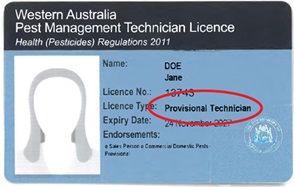
| Provisional Pest Management Technician (PT) Licence
|
Use pesticides while training to become a fully qualified pest management technician
Must be supervised by a qualified pest management technician
|
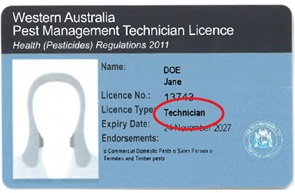
| Pest Management Technician (PMT) Licence
|
Work as a pest control technician
Handle or use pesticides for pest management treatments qualified/endorsed to undertake as listed on their licence
|
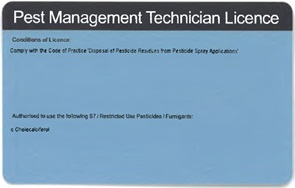
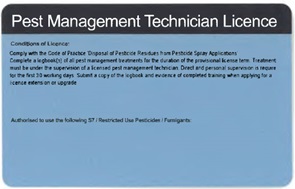
Any conditions or restrictions for the technician are listed on the back of the licence card as pictured below:
| Example1
|
Example 2
|
Approval requirements for pesticide technicians in WA (Endorsements)
To treat a certain type of pest, a pest controller must complete a specialised training course. After successfully finishing this training, the Department of Health will provide a licence that includes an ‘endorsement’ listed on the front of the card. The endorsement shows which pesticide treatments the pest controller is qualified to do.
It is encouraged to check that your pest controller has the correct endorsement on their licence before they start work.
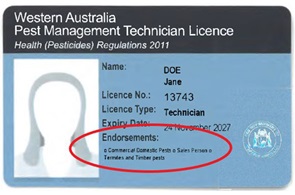
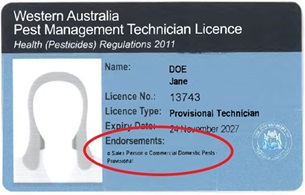
The table below lists the most common pests treated by professionals and the endorsement that must appear on the technician’s licence.
|
Common pest / control activity
|
Endorsement listed on technician licence |
- Rodents
- Ants
- Spiders
- Cockroaches
- Flying insects
- Fleas
- Bedbugs
|
Commercial Domestic Pets |
|
|
Termites and Timber pests |
- Foxes
- Feral pigs
- Rabbits
- Wild dogs
|
Feral Vertebrate Control |
- Bushland and mine site rehabilitation basic weed control.
- Lawn and garden weed control.
- Landscaping and basis weed control.
|
Basic Weed Control (Handheld/Backpack) |
The table below shows less common or additional pests treated by professionals and the endorsement that must appear on the technician’s licence.
| Additional pest /control activity |
Endorsement listed on technician licence |
- Termites (treating power poles)
|
Termite Treatment of Power Poles |
|
|
Feral Birds |
- Crops and pasture*
- Pest and weed control – non-cropping*
- Forestry*
- Turf management *
- Ovals*
- Greens*
- Firebreaks*
|
Vegetation Management (incl. Mechanical Spraying) |
- Protecting trees using phosphite
- Protecting vegetation using phosphite
|
Dieback Control |
|
|
Fumigation |
* Using mechanical spraying equipment such as boom spraying, vehicle mounted equipment, broad acre spraying equipment or air blast equipment.
Still have questions? Contact Pesticide Licencing and Compliance on (08) 9222 2000 or ehinfo@health.wa.gov.au
Have an issue? Who can you contact?
There are several government agencies that help regulate and respond to pesticide-related issues, and each has its responsibilities. The agencies listed below hold primary authority for managing many common pesticide enquiries and complaints:
- Department of Health
- Consumer Protection
- Department of Primary Industry and Regional Development (DPIRD)
- Australian Pesticides and Veterinary Medicine Authority (APVMA)
If your enquiry or complaint falls outside the scope of these agencies, the Department of Health may refer you to another authority. This may include:
- Department of Water and Environmental Regulation (DWER)
- Parks and Wildlife Service
- WorkSafe
- Civil Aviation Safety Authority (CASA)
The tables below list common pesticide concerns which agency is best to contact for assistance.
| I am concerned about |
Assisting agency |
- a pest control business operating without proper business registration
- advertising of pest control services when the business is not registered
- a pest control worker doing treatments without holding the required licence
- a licensed pest control worker not following the rules or conditions of their licence
- a pest controller applying pesticides in an unsafe manner or not in accordance with the label instructions
- a pest control worker not wearing the correct personal protective equipment (PPE)
- pest control equipment is unsafe, unsuitable, or not properly maintained
- handling, storing, transporting, or disposing of pesticides in a dangerous or unsafe manner
- lack of signage or warning when spraying pesticides in public areas.
|
Department of Health
Pesticide Safety Compliance
(08) 9222 2000
ehinfo@health.wa.gov.au
Pesticides – Licensing and industry |
- problems with payment, such as being overcharged
- a pest control company not completing the work contracted for.
|
Consumer protection
1300 30 40 54 |
- guidance on safe, compliant use of drones and aircraft for agricultural chemical application
- incorrect aerial pesticide application, including spray drift or off-target chemical impacts on neighbouring properties
- safety risks associated with drone or aerial pesticide application.
|
Department of Primary Industry and Regional Development (DPIRD)
1300 374 731
Make a report |
- health impacts from being exposed to a pesticide product that is registered for use
- use or sale of unregistered pesticide products.
|
The Australian Pesticide and Veterinary Medicine Authority (APVMA)
complaints@apvma.gov.au
APVMA - complaints |
If you are still unsure who to speak to about your specific enquiry, contact the Pesticide Licencing and Compliance team on (08) 9222 2000 or ehinfo@health.wa.gov.au for advice and guidance.
What to do if something does not go to plan with the pest control business
If you are currently experiencing or have previously experienced an issue with a pest control service or technician, the following steps can help protect your safety and support any future investigation or complaint.
1. Prioritise your safety (if it is safe to do so and you feel unthreatened)
- Try to reduce any immediate danger from the pesticide. For example:
- if the pesticide treatment is happening outside, close doors and windows.
- If the treatment has happened inside, open windows and doors to increase ventilation.
- If you can, leave the area for a short time - this might mean stepping outside, moving to another part of the property or moving away from a public area
- If it feels safe, ask the pest technician to stop the treatment
- If you feel unwell or think you were exposed to a pesticide, seek medical help.
2. Gather information (Ideally while the incident is occurring, but only if it is safe to do so)
- Take clear photos or videos of the issue
- Write down the name of the pest company and technician, including any vehicle or licence details
- Record the date, time, address of the incident and anything important you noticed
- Keep copies of documents such as invoices, quotes, contracts, emails or text messages
3. Contact your contracted pest control company
- Calmly explain the issue you experienced and the outcome you are seeking
- Keep notes of who you spoke to, the date and time, what was discussed
- Review the contract or service agreement to understand obligations and service expectations
4. If you wish to make a report
- Contact the relevant agency for assistance and support
More information
For further information on licensed pest management technicians, contact:
Last reviewed: 13-05-2026
Acknowledgements
Environmental Health
This publication is provided for education and information purposes only. It is not a substitute for professional medical care. Information about a therapy, service, product or treatment does not imply endorsement and is not intended to replace advice from your healthcare professional. Readers should note that over time currency and completeness of the information may change. All users should seek advice from a qualified healthcare professional for a diagnosis and answers to their medical questions.